
Climate Change - Our Approach
Orkney Islands Council shall be a Net Zero Local Authority, collaborating and innovating for a just transition where Orkney’s economy, communities and natural environment all prosper. We will focus on:
- Action and Ownership – to understand and reduce our emissions at the earliest opportunities
- Collaboration and Co-ordination – across Council services and with partners and the community;
- Transparency – in the setting and addressing of our carbon targets; and
- Sustainability – building our resilience and adapting to the changing climate.
The Council Plan has set a high ambition and our Delivery Plan sets actions and milestones.
- Underpinning all of our plans is the Council’s commitment to combat climate change, having joined councils around the world in declaring a climate emergency in 2019. The opportunity to grow our green and blue economies with land and sea-based renewable energy projects will give Orkney a head start in the race to net zero, reducing energy use whilst simultaneously boosting the Orkney economy and maximising benefits for local communities.
- We will update the Council’s own estate to reduce our carbon footprint, improve the energy efficiency of our social housing and facilitate affordable measures to upgrade cold homes and combat fuel poverty. The Council is implementing a Carbon management programme through to 2026. A Net Zero Transition study is also now underway and due to complete in 2025. Each year the Council submits a report on our climate action progress - available to view on the Sustainable Scotland Network.
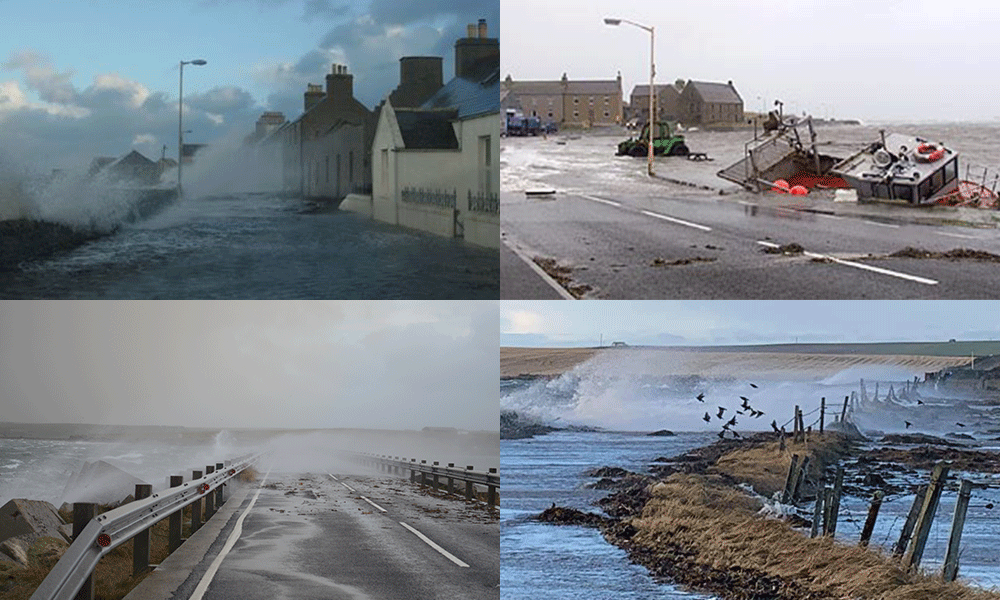
- Impacts of the changing climate are also threats to our communities in coming decades and potentially in the near term, for example through increased extreme weather events and prolonged weather periods. Adapting to the changing climate and supporting the resilience of our communities, will be increasingly important themes for the Council. The Council already provides an important resilience role and information on flooding and emergencies. In 2024 the Council responded to the Scottish Governments consultation on Climate Change Adaptation.
- The Council collaborates widely on Climate Change, especially with the thriving Orkney ecosystem of islands-based innovators and actors (across academia, business, NGOs and public agencies). We support local initiatives and the ambition from the Orkney Community Planning Partnership set out in the 2024 Climate Change vision statement.
All Public Bodies in Scotland have legal duties in relation to Climate Change – these are summarised on the SSN website. In addition to supporting emissions reduction, these duties also include supporting the delivery of Scotland’s statutory climate change adaptation programme. In 2024 the Scottish Government published the National Adaptation Plan.

Behind the Headlines – Net Zero
What’s been happening?
In February, our Policy & Resources Committee were presented with a report and an independent study, providing recommendations on how the Council can achieve Net Zero targets.
The independent study, compiled by Aether Ltd, was commissioned in August 2024 to provide the Council with independent advice on actions it can take to reduce its impact on climate change along with potential pathways to decarbonise. The study was prepared with the involvement of leading experts and drawing in a range of information regarding specialist sectors as well as the local and island context.
Why was this study commissioned?
The Council has a legal duty under the Climate Change (Scotland) Act 2009 to contribute to achieving Scotland's national climate change targets, which includes net zero emissions by 2045.
In 2019, the Council declared a climate emergency and committed to working towards a carbon neutral economy. In 2023, an ambition to be on course for net zero emissions by 2030 was set - but this was ambitious and has increasingly appeared to be unachievable.
The study provides independent assessment and recommendations to the Council, with evidence on priority actions that the Council can take to meet national and local climate change targets while supporting a wider shift to a low carbon economy. Being transparent with our progress against targets is important both publicly and for realistic transition planning within the Council.
What are the Council's main sources of emissions?
Using the most up to date available data (2023-24), the study identified that our total emissions were approximately 25,411 tonnes of CO2e. This was broken down to:
-
Ferries, tugs and harbour craft account for 48% of our total emissions - this is our single largest source. It's unusual for a local authority to operate its own ferry fleet, which is why our emissions profile is different from most other Councils.
-
Buildings (including Council offices, schools, care facilities) account for 25% of emissions - coming from electricity, heating and cooling systems.
-
Public transport - buses and the inter-island air service - account for 8%, with construction and fleet vehicles making up another 6%.
-
Other sources include other travel, waste, water treatment and tenanted properties, which make up the difference.
You can read a further breakdown in the study report in the related downloads.
Why has the target changed?
Ferries, tugs and harbour craft account for nearly half of our emissions, and with no commercially viable zero emissions options currently available, it isn’t possible to significantly reduce these emissions before 2030.
In this area, the technologies needed to achieve net zero are still in their infancy, such as the ongoing Zevi trials, so they can’t be applied to our current situation.
With recent procurement of new tugs and ongoing procurement of replacing the ferry fleet, the study identifies that some emissions will potentially or effectively be ‘locked in’ as assets have a 25–30-year life span (although it is expected that new vessels will be future proofed to incorporate lower carbon solutions over time).
Why 2045 been recommended as our new goal?
The Committee report recommended that we align with Scotland's national target by adjusting our net zero target to 2045. The Scottish Government removed their 2030 target in 2024 following advice from the UK Climate Change Committee.
To help ensure progress, however, the study also recommended that the Council develop specific decarbonisation targets for emission sources rather than a single end date target for the Council as a whole. This approach was endorsed by the Committee.
We realise that 2045 will still be challenging, but that it can be achievable if the Council positions itself to respond in due course to emerging technologies as these become increasingly available. Funding will also be a key consideration, but it presents an opportunity, as significant external support is expected to be available to assist organisations transitioning to net zero technologies.
So rather than having an unrealistic target that we’ll most likely miss, we’re being realistic and as ambitious as possible, recognising that the journey to net zero will be achieved with the support of many contributing partners, from national government and innovation funding, through to leading companies and organisations, including Orkney based pioneers that have been so active and successful in energy innovations
What are the different options presented to the Council?
The Council has previously explored a wide range of measures, set out in documents such as its Carbon Management Plan. Those were reviewed and supplemented with additional suggestions from independent experts within Aether. The impacts of measures were modelled to evaluate three potential decarbonisation pathways for the Council, representing different levels of ambition on climate change
Scenario 1 - Minimum Ambition (52% reduction by 2045): Buildings and land vehicles fully decarbonised by 2045, but no major technology change for ferries, tugs, or aircraft.
Scenario 2 - Medium Ambition (57-65% reduction by 2045): Buildings and vehicles decarbonised by 2040 (five years earlier), and some ferries and tugs get hybrid or electric systems.
Scenario 3 - High Ambition (99% reduction by 2045): Buildings and vehicles fully decarbonised by 2035 with all ferries, tugs and aircraft fully decarbonised by 2045, and small remaining emissions offset by nature-based solutions.
The report recommended that we commit to the high ambition scenario, which was agreed by the P&R Committee. The committee also endorsed the approach proposed to develop specific decarbonisation targets, rather than a single end date scenario target for the Council as a whole. The scenarios are indicative, and the exact balance of measures could vary.
What about offsetting through nature-based carbon solutions – such as peatland restoration?
Significant work is underway nationally on nature-based carbon solutions and ‘carbon insetting’, for example, from peatland restoration and appropriate tree planting.
Draft guidance from the Scottish Government indicates that these developments can count as carbon sequestration/carbon removal contributions that could balance against residual carbon emissions (should the Council not be able to fully decarbonise by 2045). This Government guidance also indicates that in the future, the wider public estate in Scotland could potentially also be used for projects (if, for example, the potential in Orkney is not sufficient on its own).
These projects can offer important carbon contributions as well as potential wider benefits, such as for biodiversity or flood risk mitigation. Projects in Orkney could not fully offset OIC’s emissions on their own, but they have a role to play to compensate for any residual emissions (following decarbonisation), and this is reviewed in the study.
Orkney has limited woodland, and conditions can make large-scale woodland creation challenging. However, contributions can be made by the appropriate planting of small woods, shelter belts and shrub/hedge species. Peatland restoration is possible at a larger scale, and some projects are already underway in Orkney by other organisations.
Given the timescales involved in such nature-based solutions, the study identifies that these types of projects need to be explored sooner rather than later. National level funding sources already exist for many nature-based schemes, and this is identified as an important opportunity for the Council’s transition and targets.
How much will all this cost?
For Orkney Islands Council, the study provides estimated costs for the mitigation actions, and these will help the Council in its future planning, funding bids and potentially in lobbying work with national government. However, there are no new funding commitments established at this time.
For some sources of emissions, the additional (net) cost of decarbonisation cannot be confirmed, and therefore only the full replacement costs are stated (e.g. ferries / marine services estimated at £308-447 million). This, of course, is not the cost of net zero itself, but is instead the cost of replacements that are low or zero carbon. In other areas, such as in buildings, the net costs are clearer, and there are many opportunities for decarbonisation. Further work will, of course, be undertaken, and the Council will always pursue best value in its capital programme.
It is important to put these costs in context, and many measures will reduce operational costs now and in future (e.g. through electrification). Overall lifetime costs can therefore be lower when one accounts for these savings over time.
Also, taking into account the existing cycle of replacement and upgrades, a large proportion of costs would most likely be incurred with or without net zero.
There are also external funding sources available, including Scottish Government grants and climate funds. In fact, the Council secured over £1m funding for Net Zero related projects in the current financial year.
Of course, taking no action will itself be costly, in terms of climate damage and the future adaptation needs. The UK independent advisor, Climate Change Committee (CCC) estimates that failing to reach Net Zero will cost significantly more than the transition itself, with inaction causing severe, long-term economic damage and higher, sustained energy costs. While the UK’s net cost of achieving Net Zero is projected at roughly 0.2–1.3% of UK GDP annually, inaction poses risks including fossil fuel price shocks and substantial climate damage.
Is the Council giving up on climate action?
Absolutely not. The recommendation to revise the 2030 target is about being transparent and realistic, based on the comprehensive evidence base that we now have through this study. It is not reducing our ambition. In fact, the study recommends the Council should target the highest ambition scenario possible and front-load emissions reductions where technologies exist now, such as heating for buildings and electric vehicles. This high ambition was agreed by the Committee.
The climate emergency remains a Council strategic priority established through the declaration in 2019 and the Council Plan 2023-28. This study provides the evidence to pursue to plan a pathway to achieve net zero.
What are the challenges and risks we face?
It’d be naïve to think that we won’t come across challenges or that committing to Net Zero by 2045 won’t be without its risks, but we must strike the right approach.
The main challenges we face are:
-
Reliance on future technologies: Zero emission ferries/tugs and aircraft are not commercially available, and there’s no guarantee they'll be ready by 2045
-
Funding gaps: Significant investment is needed with uncertain Scottish Government support and external funding.
-
Already locked in emissions: Recent purchases (tugs, boilers) could lead to 20-30 years of fossil fuel use (unless substitute fuels are tested and used).
-
Organisational barriers: There needs to be Director-level leadership across the council and officer capacity to prioritise project developments and trials.
-
Passing on the costs: If we don’t commit to a strategy now, costs will be passed on to future generations and potentially to other councils or public bodies.
It is important to note that 2045 is the goal that has been set, and even if we don’t achieve it by then, but follow our commitment as closely as possible, we will still have taken drastic steps in reducing our organisational carbon footprint, and will be significantly closer to Net Zero than we currently are. In addition, the report outlines tangible benefits from the transition, including new jobs within Orkney, health and environmental benefits and greater energy resilience.
It is also important to acknowledge that even though these challenges are significant, it isn’t a reason to be unambitious. Instead, they help us to be realistic, purposeful and transparent in our planning and timescales for action.
What are the next steps?
Officer teams from Infrastructure and Organisational Development will work alongside directorates to consider in further detail the Study’s recommendations and to prepare a more detailed programme and action plan. Progress will be reported to future Committee meetings scheduled for July 2026. From there, and taking feedback from across the Council, an initial climate change mitigation delivery plan will then be presented to the committee in November 2026.
The value of innovation
Orkney has a significant ‘knowledge economy’ which extends from the university sector through the hosting of R&D at EMEC and onto the innovative companies in the marine and renewables sector. |Following the approximately £1M investment by the Council in setting up EMEC, the organisation alone has brought over £120M of GVA to Orkney. There are other similar examples in the private sector.
There is therefore considerable benefit to Orkney through being at the cutting edge of efforts to get to net zero. Orkney’s unique combination of resources, need and ‘can-do’ attitude together make a compelling offer to investors and government alike. The value of this section of the knowledge economy is set to increase, and Orkney is well placed to play a leading role in the next two critical decades in some aspects.