

New exhibition at Orkney Museum explores Orkney’s links to transatlantic slavery
Date: 30 June 2026
Time: 12:00 PM
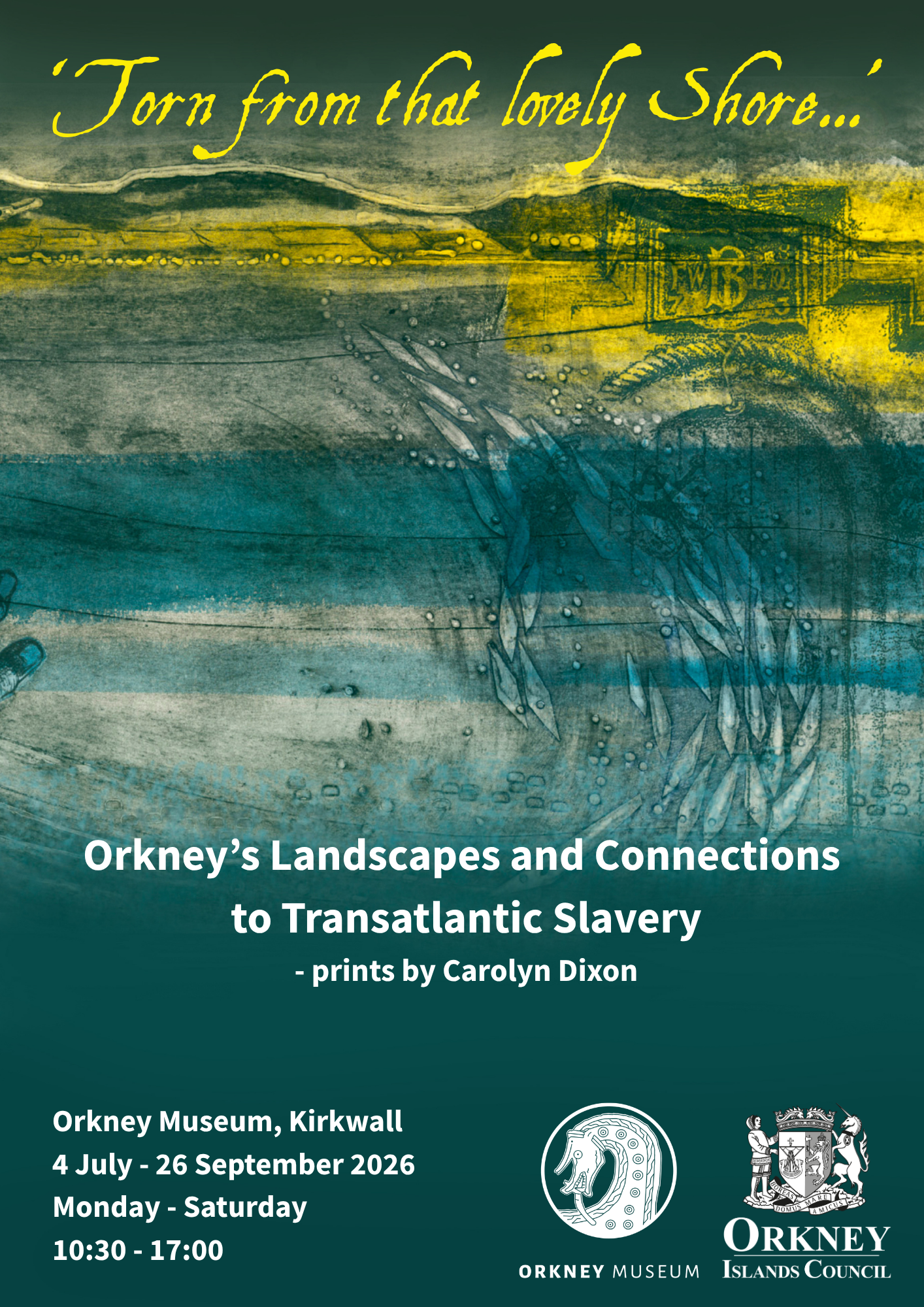
A new art exhibition exploring Orkney's historical connections to the transatlantic slave trade goes on display in Orkney Museum’s recently transformed exhibition room and runs from Saturday 4 July until Saturday 26 September 2026.
The exhibition, ‘Torn from that lovely shore…’, combines new printmaking work and historical research by Orkney-based artist Carolyn Dixon, drawing on and using archival material in the artwork.
It is the product of several years of research and development, drawing on records held in the National Records of Scotland, the National Archives at Kew in England, the National Library of Scotland, and historical societies in Pennsylvania and New Hampshire in America. A full list will be displayed with thanks in the exhibition.
Through prints, artists' books and accompanying text, Dixon tells the stories of a number of Orcadians who travelled to the Caribbean and the Americas throughout the 17th and early 19th centuries. These individuals, each in some way connected to slavery and the slave trade, were almost all the sons of merchants, mariners and ministers.
'Torn from that lovely shore...’ also explores local records which show that slavery was not unknown in Orkney itself at the time, including evidence of enslaved and formerly enslaved people present in Kirkwall and Stromness during the 18th century.
The exhibition includes historical material relating to slavery, including references to the violence experienced by enslaved people, and is intended for thoughtful engagement by visitors.
Artist Carolyn Dixon said:
“There's a saying that every picture tells a story, and that's what I hope visitors will take from this exhibition. The title 'Torn from that lovely shore' is deliberately ambiguous. For many of us today, Orkney is "that lovely shore". But when Burns wrote those words in his 1792 poem 'The Slave's Lament ', that shore was "sweet Senegal" and the person torn from it was one of the 3.5 million Africans abducted and enslaved by Britain in the 275 years of British Transatlantic slavery.”
Social History Curator, Ellen Pesci, stated:
“History doesn't always sit comfortably, and this is one of those times it shouldn't. Part of our job as a museum is to present this material honestly and in its proper context, rather than only telling the parts of our past that are easier to tell. We hope this exhibition gives people a space to look closely at this history, ask questions, and talk about what it means for how we understand Orkney today.”
Some of the historical documents and records referenced in the exhibition use language and terminology that reflects the attitudes of the period in which they were written, which visitors may find upsetting. This language is retained within the exhibition as part of the historical record and is presented in its original context.
Exhibitions of this kind have an important role to play in how local history is understood and presented. Museums are increasingly recognised as having a responsibility to research, to share the full range of a topic’s history and to provide a reflective space enabling a respectful dialogue, including chapters of a place’s history that have previously gone unexamined or are difficult to address. Presenting this material allows communities to engage with a more complete picture of the past and its ongoing legacies, rather than a partial one.
The Orkney Museum, telling Orkney's story over 6,000 years, is open Monday-Saturday 10.30am-5pm.
-
Category:
- Arts, Museums and Heritage
- Museums
