News
Behind the Headlines - Ferry Replacement Programme
20 January 2026
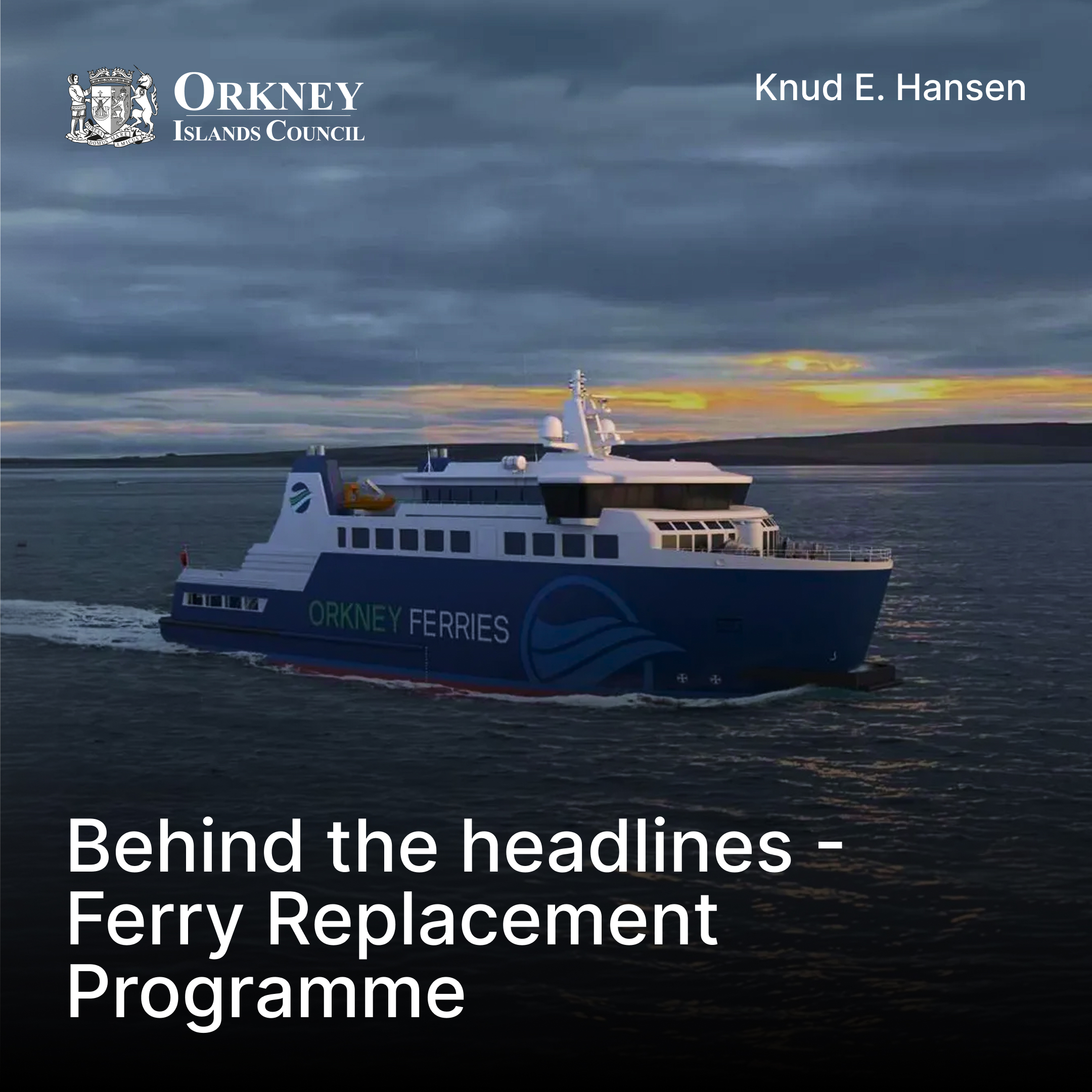
Last week Orkney Islands Council received notification from the Scottish Government, as part of the Scottish Budget 2026/27, that Ministers will provide the budget required to allow the Council to complete Phase 1 of the Ferry Replacement Programme.
Phase 1 seeks to replace the ferries which service the routes between Kirkwall in Mainland Orkney and the islands of Eday, Sanday, Stronsay and Westray.
This follows substantial engagement between Orkney Islands Council and the Scottish Government, principally through the Ferries Taskforce which has previously delivered government funding of the Ferry Replacement Programme Business Case.
The article below sets out what the Ferries Taskforce is, the funding model for replacing our ferry fleet, and what the next steps are.
When and why was the Ferries Taskforce set up?
It’s well documented that our Orkney Ferries fleet is ageing and in need of replacement. Over a number of years, the Council has been engaging with Scottish Government to tackle this challenge, looking at how the Government might support the Council with its ferry replacement plans.
The Ferries Taskforce was set up by then Finance Minister – now First Minister – John Swinney in December 2022. He wrote to then Council Leader James Stockan to say that he was committed to ‘a process to address the renewal of the Orkney internal ferry fleet’.
The Taskforce met for the first time on 31 January 2023 and since then has been considering the business case for new ferries, exploring funding sources, options and models available and feeding into the Scottish Government budget setting process each year.
In January 2025 it was announced that the Scottish Government was offering additional flexibility to the Council in the way it receives its ferry funding, by providing additional revenue funding for inter-island connectivity. This gives the Council many more options not only in how the money is spent – for example ferries, a third aircraft or the Toplander - but also in terms of the timeframe over which we can use that funding.
In May last year we updated the Taskforce on the progress we were making on Phase 1 of the Ferry Replacement Programme – progress that was made possible through the funding flexibility that had been offered.
How will the funding work – I don’t see a line in the Scottish Government’s budget saying ‘Orkney Ferry Replacement’?
The reason there isn’t a line in the budget is because – as described above – we’ve worked with the Scottish Government to create some flexibility in how we’re funding the Ferry Replacement Programme.
That means we’ve negotiated an increased amount of revenue funding for inter-island connectivity – money to run ferry services – and we will use that additional money to fund borrowing to buy new ferries – a bit like when you get a mortgage on a house.
You can see the level of the increase that has been negotiated over the lifetime of the Ferries Taskforce.
- 22/23 - £12.847M
- 23/24 - £15.829M
- 24/25 - £15.829M
- 25/26 - £20.804M
- 26/27 - £28.877M
In this years’ settlement we have had the one-off £8M revenue that we received for 2025/26 confirmed within the baseline of recurring funding and the one-off £2M of capital funding received in 2025/26 continued in 2026/27 with the indication that this will continue for the duration of the current Spending Review period. It also includes £0.187M for free U22 ferry transport on the inter-island ferry service.
That funding is now at a level where we can confidently move forward with delivering Phase 1 of the Ferry Replacement Programme, allowing future meetings of the ferries taskforce to focus on Phase 2 of the programme.
You can also see this increase reflected in the Scottish Government’s budget announcement here - Record funding for councils - gov.scot
Would it not be better for the Scottish Government to give us the funding for Phase 1 of the Ferry Replacement Programme in one lump sum (capital funding) rather than increasing what we receive on an ongoing annual basis (revenue funding)?
We completely understand that our community would have loved to have seen, in black and white, a line in the Scottish Government budget in which they provided the full funding for the ferry replacement programme.
However, we have to be pragmatic and realistic about what is achievable when the Scottish Government have many competing priorities to fund.
We have worked with the Scottish Government to find a practical way forward which will allow us, over time, to replace our ferry fleet, focussing initially on the ferries identified within Phase 1 of the Ferry Replacement Programme.
Taking this approach also gives us flexibility in how we progress with the programme. For example, having increased revenue funding over the last couple of years has meant we’ve been able to progress with the work on Phase 1 – including the outline design for the ferries, isles-based consultation process and initial tendering exercises to identify shipyards interested in the work.
It also provides us with a greater level of control of how the programme progresses – meaning we can work with our community to ensure their needs are met.
If the Council takes on additional borrowing to pay for new ferries does that not increase the risk to the Council?
While any form of borrowing carries some level of financial risk, it is important to recognise that there are far greater and more immediate risks to the community in continuing to rely on vessels that are now over 35 years old, increasingly difficult to maintain, and dependent on grandfather rights and hard to source spare parts.
In effect, we are already managing significant operational and resilience risks every day by keeping these ageing ferries in service.
Taking on borrowing to secure replacement vessels would be a managed and structured financial risk, and one that is mitigated by our trust in the Scottish Government’s ongoing commitment to supporting the renewal of the ferry fleet.
It is also worth noting that this would not be an unprecedented approach for Orkney; when the Earl Sigurd, Earl Thorfinn and the Varagen entered service, they did so under finance leases, meaning the Council was effectively borrowing for those vessels at the time. Moving to borrowing now would therefore not represent a fundamentally different model other than that we would expect it to be borrowing rather than leasing, and it remains a far safer long-term option than continuing to operate an ageing fleet with declining reliability.
What’s actually involved in Phase 1 of the Ferry Replacement Programme?
Up to now Phase 1 of the Ferry Replacement Programme has focused on the vessel outline design for the replacement Outer North Isles vessels serving Eday, Sanday, Stronsay and Westray.
That outline design is for three large vessels, up to 60m in size, which must be compatible with the existing piers and harbours infrastructure. It is anticipated that the South Isles vessel - part of Phase 2 - will be comparable in size for interchangeability during drydock, providing added resilience across the network.
The design process has involved a number of key stakeholders from the community including the Community Development Officers, Community Council Chair and Community Council Transport Representative from each island and Orkney Ferries crew before carrying out public consultation in Eday, Sanday, Stronsay, Westray and Kirkwall. The feedback from the consultation process has been incorporated in the final outline design to be followed at the next stage of the tender process – Final Design and Build.
The Council are going with a monohull conventional design, rather than a double ender or catamaran design – what led to that decision?
We appointed Leadship Design and Consulting during 2023/24 to consider the Outer North Isles network and compare three vessel types against certain operational and technical criteria – or KPIs. These were:
- Lightweight, deadweight and payload
- Cargo handling and shore interface
- Berthing and manoeuvring
- Powering requirements and propulsion
- Operability and seakeeping
The work also included a seakeeping and operability report to identify the level of operability restrictions and indicate the level of reliability and resilience for each hull form in different environmental conditions. This process was checked and validated by the Orkney Ferries crew.
The specification also outlined that the new vessel design must be compatible with the existing piers and harbours infrastructure in the four Outer North Isles and Kirkwall. There are several benefits from doing this, including the viability of the financial ‘ask’ to Scottish Government and that the vessel replacement programme would be pushed back significantly if the vessel design was subject to significant infrastructure works on each island.
What did the work of Leadship Design and Consulting find – and were the experienced Orkney Ferries crew involved too?
The vessel types examined by Leadship Design and Consulting for the Outer North Isles network were:
- Catamaran Ro-pax vessel with stern only loading capabilities
- Double Ender Ro-Pax vessel with bow/stern loading capabilities
- Monohull Ro-Pax vessel similar to existing fleet with bow/stern loading capabilities
An Orkney Ferries Operations Group was established involving the ships masters and Engineering personnel who, alongside Leadship, went through the results of the studies that had been completed. They applied a weighting to each of the performance indicators in order of importance as follows:
- Berthing and Manoeuvring (30%)
- Cargo Handling and Shore Interface (25%)
- Powering Requirements and Propulsion (20%)
- Operability and Seakeeping (20%)
- Lightweight, Deadweight and Payload (5%)
The total scores based on the results from each KPI group ranked the monohull first, the double ender second and the catamaran third.
Remember, compatibility with the existing infrastructure is critical, which in turn dictates the maximum size of future vessels. Based on the maximum size criteria and compatibility with existing piers and harbours, the results showed that from an operational and passenger comfort perspective, the monohull design was most suitable for the Outer North Isles network.
The results were fully endorsed by the Orkney Ferries crew.
Can you tell us more details on the ferries – what will be included in them?
The final outline design is for vessels which will be 60 metres in length, with seating for 190 passengers and carrying capacity of 34 cars or 10 HGVs, which is greater than the current carrying capacity of the largest of the three North Isles vessels, the MV Varagen (length: 50 metres,142 passengers in summer/91 in winter and car carrying capacity 26/28 vehicles or 120 tonnes of freight if no cars carried).
Key facilities and accessibility features include a lift from the car deck to the main deck, wheelchair seating points, changing places facility, recliner lounge, dining area, workstation with charge points, medical room, small quiet area, children’s play area, pet owner’s lounge, and crewing accommodation.
It also includes a flexible energy platform that suits present demand as well as allowing updates throughout the lifetime of the ship to suit green transition.
How did you reach a final outline design for the ferries – were the community consulted?
Preliminary designs were considered by Orkney Ferries crew, the Council’s Corporate Leadership Team (CLT), Board of Orkney Ferries, North Isles Councillors and the newly established Outer North Isles Taskforce Group which involves Community Council Chairs, Transport Representatives and Community Development Officers from Eday, Sanday, Stronsay and Westray.
This initial design then went through extensive simulator testing with Orkney Ferries crew in various weather conditions to ensure that the design is compatible with the existing piers and harbours infrastructure.
The design was then made available for public consultation to identify any areas of potential improvement. On island consultation was carried out in Eday, Sanday, Stronsay, Westray and Kirkwall followed by an Elected Members Seminar. That consultation led to a number of changes including amendments to the food and refreshments kiosk area, creation of a dedicated quiet lounge area with reclining seats and repositioning of seats to allow face to face sitting options for families and groups as well as options for people to lie down if required.
The final outline vessel design was then agreed by the Development and Infrastructure committee on 2 October 2025. You can read the papers for that and listen to the meeting here - Development and Infrastructure Committee
In November 2025 we launched a procurement exercise to identify shipyards who might be interested in tendering for the Phase 1 work. The tender will also include an option to build a fourth vessel of the same design subject to suitability for the South Isles network serving the islands of Hoy and Flotta. That tendering exercise is ongoing.
What about the rest of the fleet - the Inner North Isles, the South Isles and for North Ronaldsay and Papa Westray?
Following a competitive tender exercise, Phase 2 of the Ferry Replacement Programme was awarded in April 2025 to Arch Henderson in partnership with Leadship Design and Consulting.
Phase 2 will consider the piers and harbours infrastructure works that will be required in tandem with the outline vessel design for Papa Westray and North Ronaldsay, Graemsay and Hoy, Rousay, Egilsay and Wyre, Shapinsay, Flotta and Hoy networks.
The tender specification incorporates the Orkney Harbours Masterplan Phase 2 to avoid repetition of a review of piers and harbours infrastructure, considered under the Ferry Replacement Programme. The appointed consultants will bring a mix of civil and marine engineering expertise so that we reach outline design for both vessels and infrastructure in tandem.
An assessment of existing piers and harbours infrastructure has commenced as part of the programme.
A period of public consultation will be held in each island as the Phase 2 programme progresses.
When will the outline designs for the Phase 2 ferries – and the piers and harbours - be decided on?
It is anticipated that Phase 2, will deliver outline designs for vessels and piers and harbours works, during Autumn 2026. A key part of this process will be further engagement with the relevant communities.
Pier Ground Investigation works will be tendered and scheduled thereafter before reaching final design stage for infrastructure and vessels.
What size and type of ferries are we likely to see on these routes?
A larger vessel is proposed for the South Isles network, comparable with the new Outer North Isles vessels. These would be classed as large sized vessels in the fleet. The vessel design will be considered alongside the piers and harbours requirements in Houton, Flotta and Hoy, noting also the desire for interchangeability where possible in the Outer North Isles.
The Outline Business Case recommended that the Rousay, Egilsay and Wyre network, should get a larger vessel than what they have at present noting that the service is currently capacity constrained. A sister vessel is proposed for Shapinsay for interchangeability. Pier extensions and upgrades will be required to accommodate these larger vessels. These would be deemed as medium sized vessels in the network.
Two smaller vessels are recommended for Graemsay/Hoy and Papa Westray/North Ronaldsay, again for interchangeability.
A significant programme of infrastructure works is required to accommodate new vessels, noting that a tidal Ro-Ro service is proposed on Graemsay, Papa Westray and North Ronaldsay.
The tender for final designs will be taken forward following completion of the Ground Investigation works.
Why a separate vessel for Papay and North Ronaldsay?
The review of the Outline Business Case recommended a separate vessel for Papa Westray and North Ronaldsay. Consultation was carried out during 2024 with both communities to outline this proposal. It is anticipated that the vessel will be comparable in size and design to the new vessel for Graemsay and Hoy for interchangeability.
A dedicated vessel for the islands of Papa Westray and North Ronaldsay will significantly improve operations to these islands, particularly if services need to be rescheduled due to adverse weather conditions.
In turn, this has the potential to improve the Outer North Isles timetable for the islands of Eday, Sanday, Stronsay and Westray.